Overdue projects, your accountant on your back, building a marketing plan, all while trying to make money from your core strengths as a freelancer.
Not what you signed up for?
I get it.
When I first started writing for clients I had no concept of what task management for freelancers looked like.
My approach was more of a chaotic free-for-all that barely moved the needle on my business.
No one told me how much time I’d have to spend managing my business.
I figured I’d just write great stuff for clients, they’d tell a friend, and presto! The business would be knocking down my door.
Turns out it doesn’t work like that.
Not even close!
Building a successful home business involves all of those things and more.
The good news?
When you understand workflow management and develop a consistent, reusable roadmap, you can quickly transform your chaotic workdays into a productive and profitable freelance business that gives you the life you’ve always wanted.
In the rest of this article, we’re going to explore the strategies and tools for task management that will take you from struggling freelancer to successful solopreneur.
Let’s start with a look at mindset.
Developing A Workflow Mindset That Prioritizes Your Sanity and Grows Your Income

Why Your Workflow is The Foundation of Your Freelance Business
When I talk about developing your workflow mindset, I’m not just talking about a to-do list. That’s just a small part of it.
I’m talking about building a solid framework that will guide your entire freelance business moving forward.
With a clear structure you’ll find it easier to prioritize tasks, and avoid that feeling of overwhelm that so many freelancers struggle with.
In my first couple of years as a freelancer I was just hunting for clients on job boards. I had no idea how to run a business or handle finances and it showed when I looked at my bottom line.
Something had to change and it started with developing that consistent workflow mindset.
When you establish a consistent way to manage every task associated with your business, every little effort contributes to moving your long-term goals forward.
You become more productive, you can take on more projects, your revenue increases and so does your earning potential.
A Task Management System Helps You Avoid Burnout
There’s no getting around it.
The freelance lifestyle involves a constant juggling act between responsibilities. You’re the creative talent, the marketer, and the CEO all rolled into one.
That’s a lot of pressure if you’re not prepared for it.
Burnout is an ever present risk for all freelancers.
There’s nothing worse than that feeling of being drained emotionally, mentally, and physically.
When you create a great workflow you can avoid burnout, because you’re not constantly scrambling and guessing what might work.
You have a plan, you’re confident, and stress is at a minimum.
That’s what work-life balance looks like.
Now that we have an understanding of the mindset you need to develop to create a successful workflow as a freelancer, it’s time to take a close look at how you plan and prepare so you can succeed at each task you take on.
Planning and Preparation: Creating Structure and Consistency for Each Project
Don’t Guess — Build Your Success Roadmap
Remember earlier when I talked about the confusion and chaos surrounding my projects early on in my freelance career?
Does it sound familiar?
Well, creating a clear roadmap is the best way to avoid that.
If you don’t set clear objectives, confusion tends to rear its ugly head.
By developing a structured plan of attack that you mirror every time, you can avoid multiple frustrating revisions, and unclear expectations from clients.
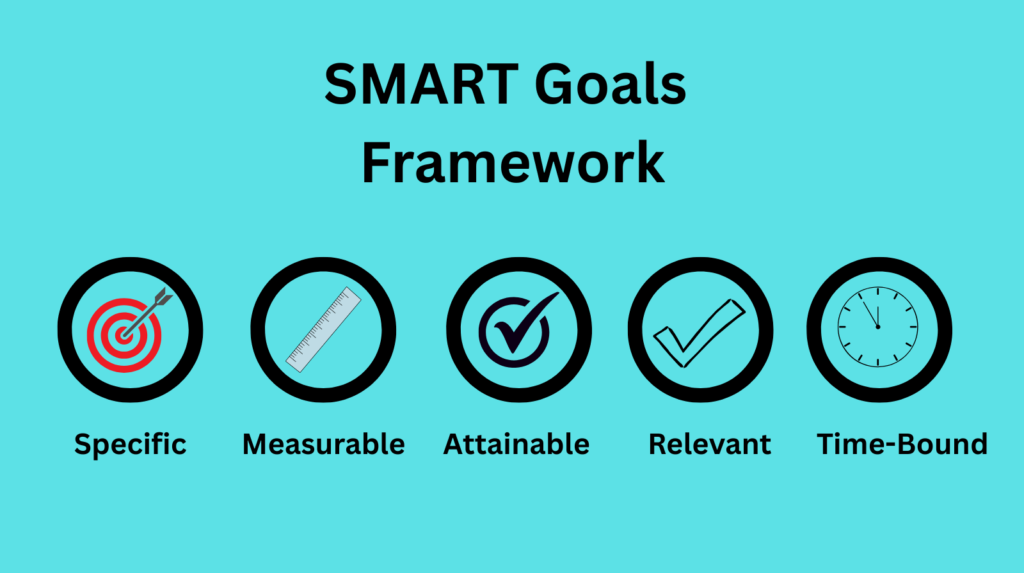
One simple solution that I use daily for my own freelance business is something known as the SMART goals framework. Each letter represents one step in setting clear goals for each task. Here’s a quick overview:
- Specific: With this step, you clearly define the task (e.g., designing a new landing page).
- Measurable: Next you develop metrics to measure success (e.g., help client increase conversions by 10%).
- Achievable: Setting unrealistic goals serves neither you, nor your client. By choosing goals that are realistically achievable you maintain momentum and stay motivated.
- Relevant: At this stage you need to be completely honest with yourself— is what I’m currently working on truly relevant or am I wasting my time? If you answer yes to this question, it’s time to mothball the project and move on to the next.
- Time-bound: This one should be pretty clear. You only have a finite amount of time available to you as a freelancer. You have to set realistic time lines for each project and stick to them.
When you’re more organized with a clear plan laid out through the use of SMART objectives, you can streamline the onboarding process with new clients.
You can clearly outline deliverables, timelines, and set milestones, when applicable, for large ongoing projects.
It’s always best to establish clarity from the beginning.
Details Matter: Stay Organized With File Management
I have a confession to make.
In my first few years as a freelancer, I lived in a constant state of “organized chaos.” The truth is I was kidding myself.
It was a lot more about chaos than it was about organization.
Details matter.
Developing a system to effectively manage files is essential to freelance success. That applies to both physical files and the virtual variety.
There’s nothing worse than needing that one file to complete a project and you can’t find it anywhere in the clutter.
It almost always leads to frustration and delays.
After a few years of dealing with a disorganized laptop, I developed a system that’s worked well for me. It looks like this:
- Create a strategic naming system for files and folders: When you use the same naming conventions consistently for naming files and folders, it becomes a lot easier to find what you’re looking for. For example, if you’re working on a project for a kitchen cabinet maker, you might name your file Kitchen Cabinet Project 2025, and files might be named kitchen_cabinet_article_1 and so on. Every client would follow this same strategic naming system.
- New project=New Dedicated Folder: Even if you plan on working with a client for a long time, each project should be stored in a new folder. For ongoing clients, this will simply be a sub folder within the client’s main folder.
- Develop a Redundancy Framework: You never know when a laptop might crash, or unfortunately, go missing. Always be prepared for the worst. Develop a redundancy system. What I mean by that, is backup your files to the cloud, save them on an external drive as well as your laptop. Whatever works for you. Just make sure you have a backup.
Take Control of Your Time As a Freelancer
Winning Strategies for Scheduling and Focus
As I write this I can hear this distant hum of a TV in our family room down the hall and the neighbor’s dog barking (Time to throw in the earbuds!).
When you work at home as a freelancer distractions are ever present and they can put a big dent in your overall productivity.
The end result?
Extra stress for you and missed deadlines for clients.
Nobody wins in that scenario.
Here are some proven methods for pushing back against the noise and chaos:
- Consistency in Your Work Schedule: Most of the time your family isn’t trying to distract you on purpose — they’re just living their life. It’s up to you to create structure, to develop a clearer line between work time and play time. Not only is your family happier when everyone knows your schedule, you’ll be way more efficient and be able to complete those daily tasks on time.
- Clusters and Time Blocking: I want you to take on a little exercise and be honest with yourself. Over a whole day track how much time you actually spend on important project tasks. Trust me, it will be no more than 3 to 4 hours. Instead of spreading that out over the work day, cluster your work into short intense sessions of 30 to 45 minutes. Set aside 3 to 4 hours for this and the rest of the day dedicate to admin tasks and rest. Your productivity will sky rocket.
- Choose Your Most Productive Hours for Intense Work: Brian Tracy talks about “Eating the Frog”. What he means by that is to jump right into those hard tasks, the ones that really move the needle first thing. That’s when most of us have higher energy and are more productive. Even if you’re dreading the task. When we take on our more demanding tasks during our peak productive hours, we get more done and make more money. Period.
Task Flow Techniques for Success
Over the years I’ve experimented with a lot of different methods for managing my work flow as a freelancer. Some of them work for me, some of them don’t.
The truth is you may try something and find it doesn’t fit your style. That’s fine. There are tons of different ways to manage your day.
Below are 3 proven task flow techniques that have worked for me and many other freelancers like you:
- The Ivy Lee Method: Some concepts hold up well over time and The Ivy Lee Method is one of them. This simple technique was first used way back in 1918. It’s a productivity method that helps you manage your priorities every day. At the end of each work day you choose six priorities for the next day (I actually narrow this down to 3). Each day you concentrate on each task, one at a time, until it’s finished. When you complete those tasks you can dive into your less important work.
- Time Batching: This is one of my favorite techniques. It involves grouping similar tasks together for the week and completing them in batches. Perhaps Monday, Wednesday, and Friday you go hard on client work. Tuesdays and Thursdays you work on marketing your business through social media, and on weekends you focus on family time and personal projects, such as updating that website and portfolio. This way you’re always focusing on the same type of work each day, you don’t have to switch focus. On average, it takes more than 20 minutes to regain focus after an unwanted interruption.
- Use Milestones: Milestones are ideal for larger projects. When you break things down into manageable pieces, you don’t feel overwhelmed. This can even be negotiated in your contracts so that you get paid per milestone. If you’re working on a project for a client that involves 9 pieces. You might set a milestone for every 3 articles. Your client gets your best work in a reasonable time frame and you get to pad your bank account so you can put food on the table.
How to Keep Burnout and Distractions Away
As I keep coming back to, distractions are always a problem as a freelancer. You can’t change reality, but you can employ strategies to deal with them and prevent burnout and frustration. Try these to start with:
- Work in Short, Intense Bursts: One of the most popular techniques for anyone working from home, especially freelancers, is to use the Pomodoro Technique to work more intensely and more focused. The ideas is to work hard for 25 minutes at a time and then take a 5 minute break. You can make the intervals a little longer if that works better for you. Personally, I use 40 minute sessions, followed by a 10 to 15 minute break. This helps to keep you focused, and the consistent breaks in between help to prevent burnout.
- Control Your Technical Distractions: It’s hard to switch off in today’s world, but you have to as a freelancer or you will find it hard to succeed. Turn off those notifications on your phone, and only check emails once or twice a day. Save the social media until the end of the work day.
- Schedule Rest and Days Off: It’s tempting to work 7 days a week when you’re first starting off as a freelancers. I can tell you from experience, that’s a mistake that leads to burnout. Schedule rest breaks during your work day. Go for a walk, spend time with family. Also, make sure to schedule at least one, if not two days every week, where you take time away from your freelance business. You need time to recharge your physical and mental energy if you want to keep those creative juices flowing and avoid mental exhaustion.
Tools and Technology to Automate Task Management for Freelancers
If you were to teleport back in time and see my desk about 5 years ago, it probably would have shocked you. I had sticky notes and pieces of paper everywhere. That was my file system.
My laptop wasn’t much better.
I managed projects using spreadsheets and very little else. I’d like to say it was organized chaos, but, if I’m being honest, that would be giving myself too much credit.
Today you won’t find a single sticky note in my physical workspace and my virtual world is no longer dominated by spreadsheets.
How did I manage to turn things around and organize my freelance life? I discovered the amazing world of project management software!
Find Your Project Management Hub
These days there are so many project management software options it’s hard to keep track of them all.
It’s nice to have options right?
How do you find the right one though?
I find it helps to group them into categories:
- Complete, All-in-One Platforms: As a new freelancer it can be helpful to find one platform that does it all. Proposals, contracts, invoicing, time tracking, task management, and Client CRM. If that’s what you’re looking for your options include Harlow, Moxie, Plutio, HoneyBook, and 17Hats. All of them offer a free trial. There are tools with a free tier, such as Wave or Zoho Invoice, but they don’t offer all of the features you’ll find with paid plans. For a reasonably priced plan, Harlow is probably the best option.
- Specialty tools: If you’re not really a Lord of The Rings fan and you don’t need one tool to rule them all (Joking), there are specialized tools with more limited capabilities that might suit you better. The one I use myself is Trello. It’s an easy to use scheduling and planning tool that makes use of Kanban boards — cards that you move along as you complete designated tasks. I find this visual representation much easier to work with. Other dedicated project and time management tools you might want to check out include Asana and ClickUp.
- Dedicated Time Tracking Apps: Even if you’re happy with your current method for project management, you might want to consider adding a time tracking app to your toolbox. These are tools such as Clockify and Toggl, which help you to track the time you spend on each project. This can be a big help when it comes time to bill clients and makes it easier to justify your rates.
Level Up With Automation
Just this past year I started using automation tools for a variety of different tasks. Personally, I’ve used Zoho, Zapier, and Make.com, but there are many more options out there.
These workflow management tools allow you to automate simple repetitive tasks such as invoicing, scheduling meetings, and tracking billable hours.
This frees up your time to focus on your core competencies and creative work. Your clients get the best of you, and you can take on more work without worrying about burnout.
In the next year or two automation will become an essential piece of every freelancers puzzle.
How to Scale By Setting Boundaries and Improving Your Client Relationship Management
Take Charge of Communication and Boundaries
About two years ago, I had perhaps the worse client experience on my freelance journey.
This client expected me to be available 24/7.
They were constantly leaving messages on WhatsApp about their latest idea, asking to set up virtual meetings every other day, and asking me to take on work that was unrelated to my area of expertise.
I had to end my relationship with this client.
Not because they didn’t pay well, they did. They were mentally exhausting!
Of course money is important as a freelancer, but there will always be other clients.
Here are a few things you can do to avoid these types of situations by establishing communication rules and clear boundaries:
- Set Clear Expectations Upfront: When you first take on a new client make it a priority to discuss communication methods upfront. Establish reasonable response times for queries, and agree on a preferred platform for communication.
- Create Realistic Timelines: While it’s tempting to try and impress a new client with your speed, don’t do it. Set realistic timelines, and if this new client counters with something you find unreasonable, walk away. Over extending yourself will result in burnout and/or frustrated clients when you don’t meet their requested timeline.
- Be Open and Honest: Always clearly communicate with your client. If you’re falling behind don’t avoid them. Things happen in life and most clients understand this. When you’re faced with a bit of a hiccup, let your client know right away. They might not be thrilled, but being upfront about it, will always lead to a better outcome.
- Track Your Time and Communicate it With Your Client: Sometimes a project takes a little longer through no fault of your own. It might just be a bit more complicated than either you, or your client anticipated. When you track your time and add every detail to your invoice, it’s easier to justify unavoidable delays.
Build A Strong and Secure Foundation
At the beginning of my freelance journey I ran up against many misunderstandings, frustrations, and general difficulties.
Most of them would have been avoidable with a stronger foundation and a clearer vision over all.
Here’s how you can avoid this for yourself:
- Create Secure Agreements: There are many tools out there that allow you to create and secure contracts quickly using digital signatures that prevent misunderstandings. Dropbox Sign is a great example. Keep a copy of this signed version in each client’s folder under the current project you’re working on.
- Build a Strong Portfolio: Don’t fall into the trap of creating a portfolio and then forgetting about it. As a freelancer you will continue to grow and evolve, so should your portfolio. I would suggest reviewing it once a month. Add in your best recent work and create a standard process for sharing your updates with clients whether that’s through direct communication or over social media.
- Consider Outsourcing: There comes a time in every freelancers journey when it becomes difficult to manage every aspect of their business. If you’re overloaded with work, consider outsourcing simple tasks to a virtual assistant. You may even want to consider scaling up and joining forces with other freelancers to expand your reach. Outsourcing isn’t for everyone, but it isn’t something to be afraid of either.
Take Control of Your Task Management and Your Freelance Future
What’s next?
Well, now it’s time to for you to choose the tools and approaches that work best for you to develop a healthy freelance mindset.
Don’t be afraid to experiment a little.
If one tool or method doesn’t fit well, try something else.
You might love using SMART objectives, but find the Ivy Lee Method less helpful. There’s no one right way to take on task management for freelancers.
Once you find the right tools and strategies you’ll notice a boost in your productivity, your stress levels will go down, and you’ll have a foundation for growth for years to come.
Ready to get started?
I’d love to hear about your experiences and the tools you choose.
When you’re ready, drop me a note and tell me how the journey’s going.