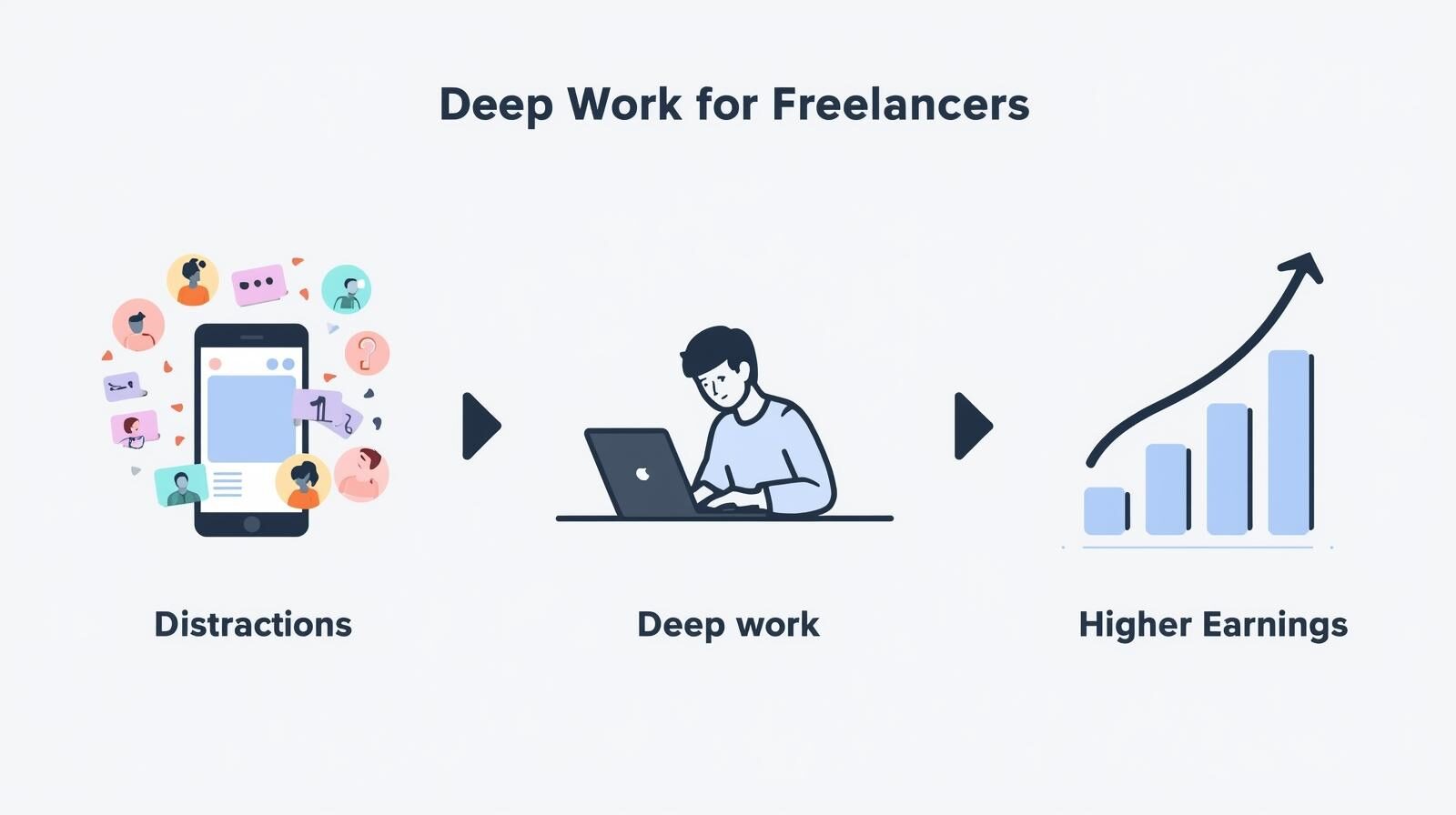
How does deep work for freelancers help with focus and how will it help you earn more?
Before I can answer that let’s take a step back.
When I first started freelancing I pictured freedom, flexibility, no more boss. Who doesn’t want that right?
The reality?
One year in I was stressed out by unrealistic client demands, constant interruptions, and a more chaotic life than I ever dealt with working in an office.
My Whatsapp notifications were going off at all times of the day, the pull of social media was a constant distraction, and the neighbors dog was sure to let me know every time someone approached the door.
I couldn’t focus, it took me forever to finish a project, and my income suffered.
The hard truth?
Demands on your attention are everywhere when you’re a freelancer.
If you don’t learn how to handle the distractions when working from home early on in your freelance journey, your bottom line will suffer.
Every dog barking, doorbell ringing, and unwanted notification on your phone is pulling you away from your work and destroying your focus.
It hurts your productivity and it hurts your revenue.
That’s when I discovered Deep Work, a concept introduced by Cal Newport way back in 2016 (Okay, not that far back), that helps you cut through the noise and focus on what matters.
It can become your freelance superpower, driving your success as a solopreneur.
In this guide you’ll learn how it applies to you, and how it will make you more money!
Let’s dive in.
Deep Work vs Shallow Work: What Freelancers Need to Know
When I first started freelancing back in 2014 I was drowning in “shallow work”, I just didn’t know it.
No one was talking about the difference between deep work and shallow work back then so I was left to muddle along trying to keep my head above water.
That all changed when I read Cal Newport’s book Deep Work: Rules for Focused Success in a Distracted World in 2016.
This book was a game changer for freelancers like me.
Why?
Let’s start by defining what deep work and shallow work are and what they mean to freelancers.
What Does Deep Work for Freelancers Really Mean?
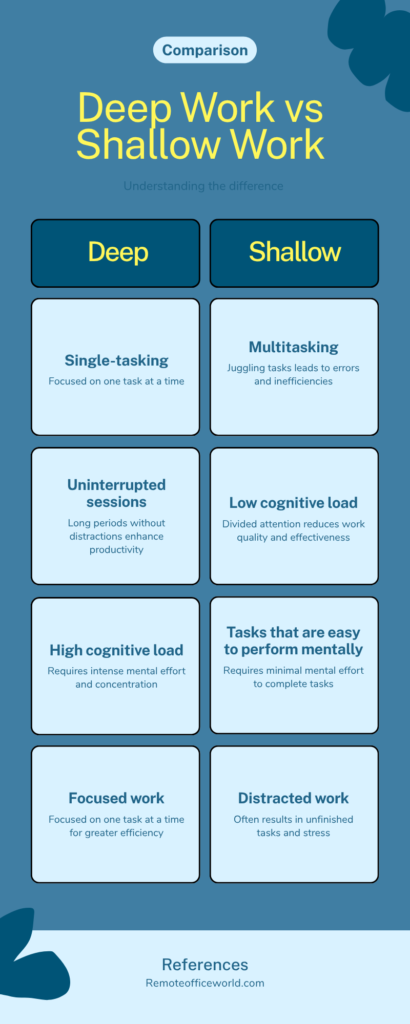
Deep work is about removing the distractions, focusing in on one task at a time, and pushing your brain power to its limits.
If I told you that you’re wasting 80% of your time on meaningless stuff and deep work can fix it would that get your attention?
When you adopt the deep work philosophy, your focus improves, you develop new skills and you’ll have more money in your pocket.
Sounds great right? But what does it look like?
Here are a few great examples to help clarify what deep work is:
- Developing detailed and focused client strategies
- Writing comprehensive and powerful proposals
- Writing game changing code for breakthrough software
- Diving deep into groundbreaking research
What is Shallow Work?
On the flip side shallow work tasks are those you do every day.
They don’t require a lot of brain power, they’re mundane, but they’re constantly pulling you away from the work that really moves the needle or helps with your long-term goals.
Think:
- Constantly checking your email every five minutes
- Those daily meetings that drag on and veer off topic
- Frequent messages from clients on minor details
- Scheduling and filing tasks
These tasks have some value to your freelance business, but they’re not big picture stuff and they shouldn’t be allowed to interrupt your focused work.
How Shallow Work Kills Freelance focus and Income

There’s a term that’s often thrown around in productivity circles — “attention residue”.
Let’s look at an example to understand how it works.
Yesterday I was starting on a new project for a client. I figured I’d set aside the day for deep research, the problem is I forgot to remind the family I was working and I didn’t throw on my noise cancelling headphones.
In the first 15 minutes of research I was interrupted 3 times, by a family member and twice by phone notifications.
The result?
Every time I tried to go back to my work, one of those interruptions was taking up space in my mind.
This is attention residue.
When you’re constantly jumping back and forth between tasks, it’s hard to maintain focus on the big picture items.
Some of your attention is still being sucked up by that minor every day stuff.
You never quite fully engage with your current project.
In my case, my research was going nowhere!
It’s estimated that as much as 40% of our productive time is wasted on constantly switching our attention between tasks.
How long does it take to regain your focus?
That depends on the individual and the nature of the interruption, but for many freelancers, it takes more than 20 minutes to fully regain focus.
Over the course of an 8 hour day, that’s a lot of wasted time!
How to Build Your Deep Work Fortress
When you work at home you don’t have the structure of a traditional office.
There’s no cubicle to hide in, no coworkers hard at work on their own tasks, no office door to close.
You have to build the structure in your life and figure out how to create an environment that allows you to stay focused.
Optimize Your Workspace for Maximum Freelance Focus
Have you ever had to work in an uncomfortable work environment?
I have and it sucks.
Having to bend your neck to view your laptop screen, trying to get comfortable in a crappy old chair, working at the kitchen table.
These are all realities many freelancers struggle with every day.
Before you can even begin to think about focused deep work, you need to fix this unhealthy setup.
Your workspace is your success center as a freelancer.
Treat yourself to a comfortable ergonomic chair, buy a laptop stand that puts your screen at eye level, invest in an ergonomic bluetooth keyboard and mouse.
Every shift in your chair, rub of your neck, and cramp in your leg is a distraction.
If you’re comfortable while you work it’s easier to focus and it’s a lot better for your overall health. Both mental and physical.
Find a dedicated space to work as well. Don’t work in the living room in front of the tv.
If you don’t have a dedicated office, at least create yourself a dedicated corner and invest in a good pair of noise cancelling headphones.
Make it clear to the family that when you’re in your space, and those headphones are on, so is the do not disturb sign.
How to Schedule and Stick to Deep Work Sessions
It’s tempting to cancel or postpone a deep work session because something else “came up”.
Don’t do it!
Think of it this way, you wouldn’t cancel an important meeting with a client, why would you cancel a deep work session that’s going to make you money?
There are always excuses that get in the way.
Ignore them and stick to your schedule.
Follow this simple framework to get started:
- Find Your Golden Energy Times: No two freelancers are alike. Personally, I work better first thing in the morning. That’s when I choose to do my focused work. Other people can’t function until they’ve had three cups of coffee and a morning jog. Identify your Golden Energy Time, the time when you hit your peak energy levels, and schedule your deep work sessions during those times.
- Choose a Philosophy that Fits: There are countless ideas and philosophies for how to approach deep work. For freelancers, the Rhythmic Philosophy is often the best to follow. You build a daily rhythm by scheduling a 1 to 4 hour chunk of deep work daily at roughly the same time every day. It becomes routine for both you and your family, that makes it easier to stick to.
- Start With Smaller Timed Sessions: Currently I work on 40 minute cycles of deep work, but I’ve been freelancing for over a decade. That can be hard to stick with at first. Start with smaller sessions. With the Pomodoro technique you start with 25 minute sessions of focused work followed by a 5 to 10 minute break. This is a great starting point. Once you get used to that, scale up to 40, 60, and even 90 minute sessions — depending on the nature of the work.
How to Set Freelance Client Boundaries to Protect Focus
In the early days of my freelance life I had a couple of clients that were very demanding.
It seemed like every thought that popped into their head they were reaching out to me to ask for a tweak to a project.
One of these clients would ask to talk about his new ideas on the phone, at least once a day.
This was both physically and mentally draining.
It was unsustainable.
The problem was I was too afraid to lose clients, because I was new to the game. I bent over backwards and I paid the price.
Within a few months I was feeling burnt out and ready to quit.
Defend Your Mental Health: Set Clear Expectations With Clients
As a freelancer you’re in complete control of your day. At least you should be if you want to be productive and make real, life changing money.
You control how much deep work you do each day and you control how much of your day is spent on shallow work.
Getting this balance right, is critical to your success.
Here are three rules to follow to maintain balance between productivity and keeping clients happy:
- Control Your Client Communication: Having to respond to every client request instantly will destroy your focus and tank your productivity. Make it clear to new clients what your response times are (For example, you only check email & messages first thing in the morning, at lunch, and at the end of the work day). This sets a clear boundary and they’re not upset when you don’t respond right away. If they are, they’re not a good fit for you.
- Set Designated Blocks of Time For Shallow Work: Shallow work has to be done — but not when you’re supposed to be focusing on a major project. Set aside time for low effort tasks such as checking email, invoicing, and scheduling. These need to be done daily, but don’t interrupt your deep work to do them. When you have a set block of time for these tasks, you’ll find your inbox is cleared out as well as when you check on it constantly throughout the day.
- Create a “Don’t Respond Rule”: Another key concept that Cal Newport introduced is that you don’t have to respond to everything. If an email is open ended without a real question, doesn’t interest you, or if answering it wouldn’t be helpful, ignore it. You don’t have to respond to every message that crosses your desk. After all, you’re a freelancer, you make your own rules!
The Best Tools for Freelancers to Stay Focused and Productive
Technology can be distracting, but not if you use it to further your goals as a freelancer.
Doom scrolling through TikTok won’t move the needle on your business, but building a workflow automation with Make.com will.
Using the right technology for your freelance business can help you stay more focused. Here are 4 great examples of the types of apps that can help you create a successful deep work environment when working from home as a freelancer:
- Distraction Blocking apps: I’m a bit of a news fanatic, so headlines are constantly popping up on my phone. When I’m trying to focus on an important project this is a big distraction. That’s where apps like Freedom or Cold Turkey come in. They make it easy to block websites and apps during your focus sessions.
- Task Labelling Apps: Apps like Todoist and Trello make it easy to label work as shallow or deep. These give you a quick visual reminder of how focused you should be on a given task and help to keep you on track.
- Time Tracking and Metrics: If you don’t keep track of your time or measure your productivity, how are you supposed to improve? Fortunately, there are apps for that and they can help you keep score and set goals for yourself. Some great examples are Tivazo and Monitask. They can make it feel effortless to handle important projects and track your time. Timely is another great option that’s good for deep work. With this app you can start to learn how long certain tasks take you. Making it easier to set aside the right amount of time for each task.
- Time Blocking Apps and Timers: One of my biggest issues when working on big tasks was staying focused over a set period of time. Adopting the Pomodoro Technique was the answer I had been looking for. Whether you use a simple timer or dedicated app, setting defined blocks of time (25 minutes is standard with the Pomodoro Technique) is a major productivity boost for freelancers.
How to Maintain Deep Focus and Avoid Freelance Burnout
Adding deep work sessions to your day as a freelancer can be a major boost to your productivity and profitability.
They’re also mentally demanding.
It’s not something you can sustain for the whole day.
There’s a clear limit to how much deep work we can take on each day so if you want to set yourself up for success follow these guidelines:
- Set Realistic Limits: Freelancers are knowledge workers and most knowledge workers find it difficult to commit to more than 3 to 4 hours of intense, deep work each day. As I write this, I’m coming up on hour 4 and I can feel the strain. When you stretch your deep work beyond these limits, you’ll find it hard to stay focused and you won’t produce your best work.
- Develop a Deep Work Routine: We’re creatures of habit. If you can create a regular routine or ritual for your deep work sessions, you’ll find it easier to stick with it. For example, you might start by brewing that second cup of coffee, throwing on your headphones and firing up your focus playlist. Whatever works for you. The ideas is to signal to your brain it’s time to get serious. It’s time to focus.
- Build in Break Time: I find 4 hours is about the max amount of deep work I can do each day, but I don’t do it all at once. I use a modified Pomodoro Technique, with a timer, to set up 40 minute sessions, followed by 15 to 30 minute breaks in between. Your mind needs time to rest and recharge. Get away from your laptop and your phone. Have a snack, go for a walk. Deep breaks are as important as deep work.
- Make Sleep a Priority: A well rested brain works better. For adults that means a minimum of 7 to 9 hours every night. Anything less than 6 and you’ll find it hard to focus on any major task. If you want to increase your focus and improve your critical thinking skills, get more sleep!
- Develop Your Shutdown Ritual: Human beings like routine. This applies to both complex and simple tasks. That’s why developing a daily shutdown ritual can be a major boost to how well you handle daily deep work. Get in the habit of setting 3 goals for the next day, then closing your laptop, placing it on the same shelf, turning off your desk lamp and walking away from your work space. Whatever routine works for you. Make it part of your daily routine and you’ll find it easier to stay focused and refreshed. It gives your brain the signal that the work day is done and it’s time for rest, leisure time and relaxation.
Your Freelancer Deep Work Action Plan
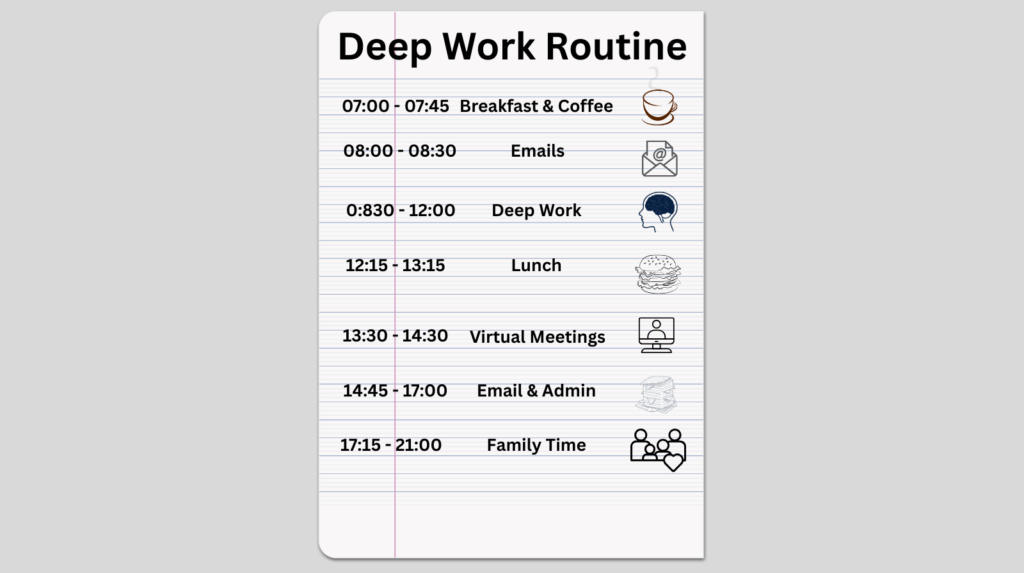
Adopting a deep work action plan isn’t only about being more efficient with your time. It’s about gaining a strategic edge in a competitive world.
Freelancers that consistently commit to daily focused deep work are better thinkers, better creators, and perform better. More importantly, they earn more money!
There are clear benefits and few drawbacks to making deep work a big part of your daily routine.
Why?
Because better focus leads to higher quality work, that leads to more satisfied clients, and satisfied clients leads to higher rates and consistent work.
You’ll probably always battle with distractions, no matter how good you become at deep work, but with a plan in place and a daily routine, you’ll find your day is less chaotic and more profitable.
If you’re going to make it as a freelancer, deep work isn’t a nice to have, it’s a must have. Protect yourself against the noise and distractions.
Start building your plan today!